HVAC Proposals: How to Quote Good, Better, Best
Picture the kitchen table. The old system died in August, the house is 84 degrees, and you’ve just slid one price across: $11,400. The homeowner goes quiet. Now they’re not deciding which system to buy. They’re deciding whether to buy from you, or call two more companies and wait.
Three options change that conversation. Instead of yes or no, it’s “which one?” And “which one?” is a much easier question to answer at 84 degrees.
Short answer: quote three complete, correctly sized systems that all meet your region’s efficiency minimum. Step up efficiency, comfort and warranty from Good to Better to Best, price each from its own cost and margin, show the matched-system rating, and say in one line who each option suits.
Why do three options work better than one?
Because people compare. Give them one price and they compare it with a competitor’s. Give them three and they compare your options with each other.
Researchers have a name for what happens next. In a well-known 1989 study in the Journal of Consumer Research, Itamar Simonson found that people tend to choose “the alternative supported by the best reasons”, and that an option gains share when it becomes the middle, compromise choice (Simonson, 1989).
That’s useful, not sneaky. It means your middle option should be the system you’d genuinely put in your own house, priced so it pays you properly. Good and Best are honest alternatives on either side.
What should each tier include?
The same correct size, and everything else stepping up. Here’s a simple way to build them for a Florida split-system replacement:
| Good | Better | Best | |
|---|---|---|---|
| Efficiency | Meets the regional minimum: at least 14.3 SEER2 (split AC under 45,000 Btu/hr) | ENERGY STAR level: at least 15.2 SEER2 and 12.0 EER2 | Your highest-efficiency matched system |
| Comfort | Reliable single-stage system | Step up in comfort features you stand behind | Your top comfort and humidity-control features |
| Warranty and service | Manufacturer warranty, your workmanship warranty | Adds a maintenance plan or longer labor warranty | Longest labor warranty and maintenance plan |
| Who it suits | ”Selling in a few years, or on a tight budget" | "Staying put and wants lower bills" | "Wants the quietest, most efficient system we offer” |
Sources for the numbers: DOE’s central air conditioner standards guidance and the ENERGY STAR Version 6.2 specification. For split heat pumps, the national minimum is 14.3 SEER2 and 7.5 HSPF2, and ENERGY STAR asks for 15.2 SEER2, 11.0 EER2 and 7.8 HSPF2.
Three rules keep this honest:
- Same size in every tier. If you upsize the Best option to make it look bigger, you’ve changed the job, not the tier.
- Good is not a trap. It’s a compliant, correctly installed system you’d be happy to service for years.
- Change only what’s different. Labor, permit and the parts of the install that don’t change should read the same on all three, so the comparison is clean.
What efficiency rules does your Good tier have to meet?
Your region’s DOE minimum, and in the South that’s checked by install date. DOE’s guidance puts Florida in the “hot-humid” Southeast region. Since January 1, 2023, a split central AC installed there must be at least 14.3 SEER2 below 45,000 Btu per hour, or 13.8 SEER2 at 45,000 and above. DOE adds: “It is illegal for your air conditioner contractor to install a product that does not meet the regional standards in the Southeast and Southwest.”
Two small things trip people up:
- SEER2 isn’t SEER. DOE says the new ratings “are not directly comparable” to the old ones. If the homeowner’s old unit says “16 SEER”, don’t line it up against a SEER2 number as if they’re the same scale.
- The rating belongs to the match. AHRI says that for split systems it certifies “the performance of the system and not the individual units”, and gives each matched pair a Certified Reference Number (AHRI). Put that number on each tier.
What changed for 2026?
Two things that belong on, or off, your proposal:
The federal tax credit is gone for new installs. The IRS says the 25C Energy Efficient Home Improvement Credit “will not be allowed for any property placed in service after December 31, 2025” (IRS fact sheet on P.L. 119-21). If an old template still says “qualifies for up to $2,000 tax credit”, take it out. Utility rebates may still apply, so check your local utility’s program before you mention one.
R-410A got a reprieve, with limits. In May 2026 the EPA removed the January 1, 2026 installation deadline for residential systems using higher-GWP refrigerants, when the components were made in or imported into the US before January 1, 2025. That older inventory “can be installed until supply runs out” (EPA fact sheet). Newer components need a lower-GWP refrigerant such as R-454B or R-32. Say which refrigerant each tier uses, so nobody is surprised at the next service call.
How do you price each tier?
From its own cost, with your margin, not by adding a fixed amount to the tier below. Add up equipment, materials, labor, permit and your overhead share for each option, then use the formula from our markup vs margin guide: price = cost ÷ (1 − margin).
If Better costs you more to install (a longer warranty you’ll honor, more setup time), that cost belongs in Better’s price. Pricing each tier from scratch is how Best ends up paying you more, not just costing the homeowner more.
A note on paperwork: in Florida, HVAC work needs a licensed air-conditioning or mechanical contractor (Fla. Stat. §489.105), and changeouts need a permit. The City of Doral’s building department, for example, lets contractors replace equipment in an emergency but requires the permit application to be “complete and paid for before the completion of the replacement” (City of Doral). Check your own city or county, and put the permit fee on every tier.
Your good, better, best checklist
- Load calculation done, one size for all three tiers
- Good meets the DOE regional minimum for your area
- Better and Best step up efficiency, comfort and warranty
- AHRI reference number and refrigerant listed on each tier
- No federal tax credit promised for 2026 installs
- Each tier priced from its own cost and margin
- One plain line on who each option suits
- Permit fee included in every tier
When it’s time to choose what kind of document to send, quote, estimate or proposal helps, and online quote acceptance shows how the homeowner says yes from their phone.
How simpleWhirks Proposals handles this
Here’s what simpleWhirks Proposals does today, and where it stops.
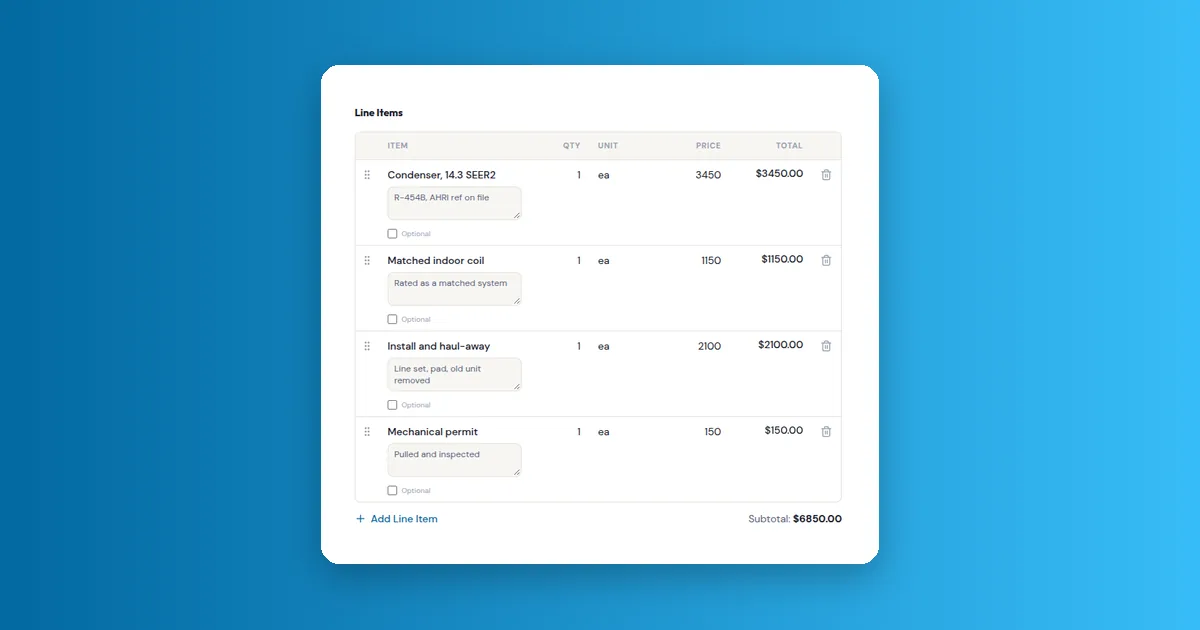
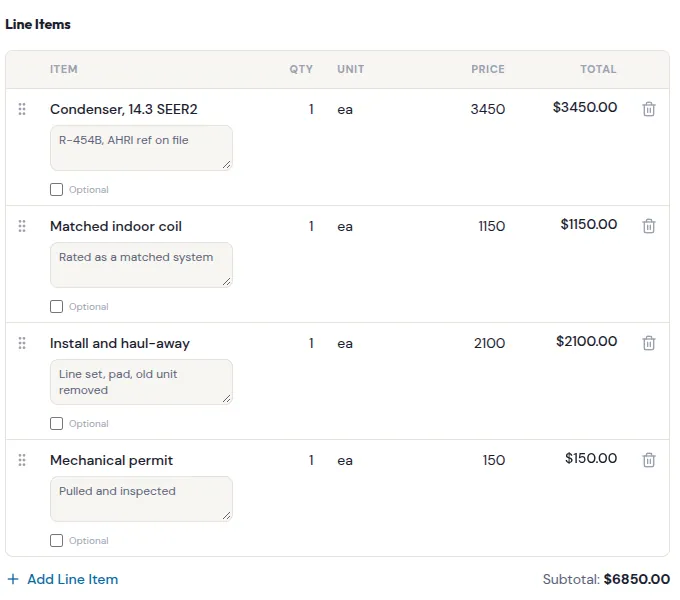
One proposal per tier. Build the Good option in the Quote Builder, with each line’s title, quantity, unit, price and a short description (model numbers, SEER2, AHRI reference number, refrigerant, warranty). Then Duplicate it for Better and Best and change only what’s different. Name them clearly, such as “Good: 14.3 SEER2 split system”.
Save your tiers as templates. Once a set of options works, Save as Template on each, so next week’s replacement starts from all three.
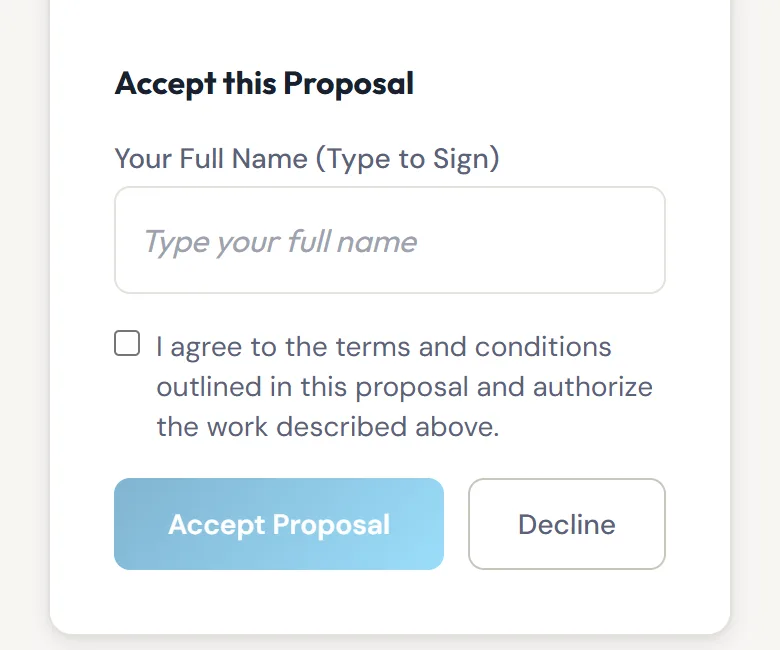
The homeowner accepts the one they want. Each proposal goes by email with a link. The homeowner opens it on any phone or computer, types their full name and ticks “I agree” on their choice; the name, date, time and where they accepted from are saved. The others can be declined, or simply expire (30 days by default). You’re emailed when they accept.
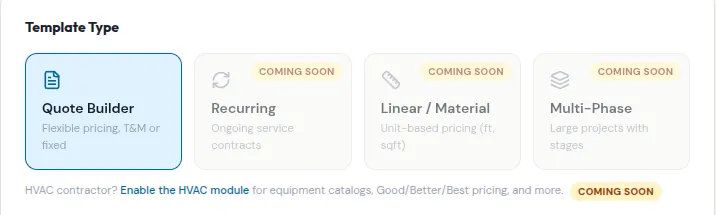
What it doesn’t do yet: there’s no single proposal with three side-by-side options to pick from. You send three, and the homeowner gets one email per proposal. The HVAC module, with an equipment picker and built-in good, better, best options, is marked Coming Soon under Settings → Modules. And Proposals stores your prices, not your costs, so it won’t show your margin per tier.
About the author
Travis Sutphin is the CTO and co-founder of simpleWhirks. He built simpleWhirks Books and Proposals because the alternatives made him angry, and he writes about how they work: what’s stored where, what we chose not to build, and what doesn’t transfer. More from Travis.
Efficiency standards, refrigerant rules and tax law change. This post reflects the official pages linked below as of its publish date. Check current requirements, and talk to a tax professional before telling a customer about any credit.
Frequently asked questions
Defined Terms
- SEER2
- Seasonal Energy Efficiency Ratio 2, the cooling efficiency rating used for new equipment since 2023. Higher is more efficient.
- EER2 / HSPF2
- EER2 is cooling efficiency at peak heat; HSPF2 is a heat pump's heating efficiency.
- Matched system
- A specific indoor and outdoor unit pairing with its own certified rating and AHRI reference number.
- Compromise effect
- The tendency to choose the middle of three options because it's the easiest choice to justify.
- Regional standard
- DOE's higher minimum efficiency for central air conditioners installed in the Southeast and Southwest.
Sources Cited
- US Department of Energy, Central air conditioner standards guidance (2023)
- ENERGY STAR, Version 6.2 Central Air Conditioner and Heat Pump Specification and air-source heat pump criteria
- AHRI, How and why products are certified
- IRS, FAQs on sections 25C and 25D under P.L. 119-21 and Energy Efficient Home Improvement Credit
- US EPA, Technology Transitions final rule fact sheet (May 2026)
- Simonson, I. (1989), Choice Based on Reasons: The Case of Attraction and Compromise Effects, Journal of Consumer Research 16(2), 158–174
- Florida Legislature, Fla. Stat. §489.105
- City of Doral Building Department, Air conditioning emergency replacement procedures
Related reading
Markup vs Margin: How to Price a Job That Pays You
A 20% markup isn't a 20% margin, and the gap is where profit goes missing. Here's the simple conversion, a cheat-sheet table, and how to price jobs right.
Proposals · Winning JobsQuote vs Estimate vs Proposal: What to Send a Customer
A quote is a fixed price, an estimate is a guess, a proposal is the scope plus the price. Here's which to send, and how a signed one becomes an invoice.