Markup vs Margin: How to Price a Job That Pays You
Here’s a scenario that plays out in a lot of trade businesses. A deck builder prices every job the same way: materials plus labor, “plus 20%, call it good.” The owner plans the year around keeping 20% of sales. Then the year ends, the books get added up, and the margin is 16.7%. On $300,000 of sales, that’s about $10,000 the owner counted on and never had.
The math wasn’t wrong. The 20% was just measuring something different from what the owner thought it was.
Short answer: markup is what you add on top of your cost; margin is the share of the final price you keep. A 20% markup on a $1,000 job prices it at $1,200, and your margin is 16.7%, not 20%. To hit the margin you actually want, divide your cost by one minus that margin.
What’s the difference between markup and margin?
They measure the same profit against two different things. Markup compares profit to your cost. Margin compares profit to the price.
On a job that costs you $1,000 and sells for $1,200, the profit is $200 either way. Against the $1,000 cost, that’s a 20% markup. Against the $1,200 price, it’s a 16.7% margin. Neither number is lying. They’re just answering different questions, and the one your bank account cares about is margin.
Why does a 20% markup only make 16.7%?
Because the base changed. You added 20% of the cost, but you’re now measuring against a bigger number, the price.
Here’s the math, done properly:
- Cost: $1,000
- Add 20% markup: $1,000 × 0.20 = $200
- Price: $1,200
- Margin: $200 ÷ $1,200 = 16.7%
That missing 3.3% is the deck builder’s lost profit. On one $1,200 job it’s $40. Across $300,000 of sales it’s about $10,000.
How do you convert markup to margin (and back)?
Two little formulas cover it. In plain English first:
- Markup to margin: divide the markup by one plus the markup. A 25% markup: 0.25 ÷ 1.25 = 20% margin.
- Margin to markup: divide the margin by one minus the margin. A 25% margin: 0.25 ÷ 0.75 = 33.3% markup.
And the one you’ll use most, because it starts from what you want to keep:
- Price for a target margin: cost ÷ (1 − margin). A 25% margin on $1,000 of cost: $1,000 ÷ 0.75 = $1,333.
Or skip the math and use the cheat sheet:
| Markup on cost | Margin on price | Price on a $1,000 cost | You keep |
|---|---|---|---|
| 10% | 9.1% | $1,100 | $100 |
| 20% | 16.7% | $1,200 | $200 |
| 25% | 20% | $1,250 | $250 |
| 33.3% | 25% | $1,333 | $333 |
| 50% | 33.3% | $1,500 | $500 |
| 100% | 50% | $2,000 | $1,000 |
What costs should go into the price before you add anything?
Everything the job costs you, including the things that don’t feel like they belong to the job. Markup on an incomplete cost is still an incomplete price.
The obvious ones are materials and labor, and that includes your labor, even if you don’t pay yourself an hourly wage. The sneaky ones are overhead: insurance, the truck and its fuel, phone, software, tools that wear out, and the hour you spent on the phone and the drive to quote it.
A simple way to fold overhead in: add up a year of overhead, divide by the number of jobs you do in a typical year, and add that amount to every job’s cost before you price it. If $18,000 of overhead is spread over 60 jobs, every job carries $300 of it before you’ve bought a single post.
How much should a small contractor mark up?
Work backwards from the margin you need, not forwards from a percentage someone mentioned at the supply house.
Start with what you need to keep: enough to cover overhead (if you haven’t already put it in the cost), pay yourself properly, and leave something for slow months. That’s your target margin. Then use the formula: cost ÷ (1 − margin). The markup is whatever falls out. It’ll be different from your neighbor’s, and that’s fine, because your truck, insurance and hours are different too.
How do you charge more without losing the job?
Show the customer what the price covers. People argue with a number; they rarely argue with a clear list.
A single figure at the bottom of a text message invites haggling. Line items with plain descriptions, quantities and units invite questions, and questions are easier conversations. If a customer wants it cheaper, offer a smaller job (a shorter run, a simpler gate) rather than the same job for less. That keeps your margin and gives them a real choice. Our guide to quotes, estimates and proposals covers which document fits which job.
How simpleWhirks handles this
Proposals is where the price meets the customer, and Books is where you find out whether it worked.
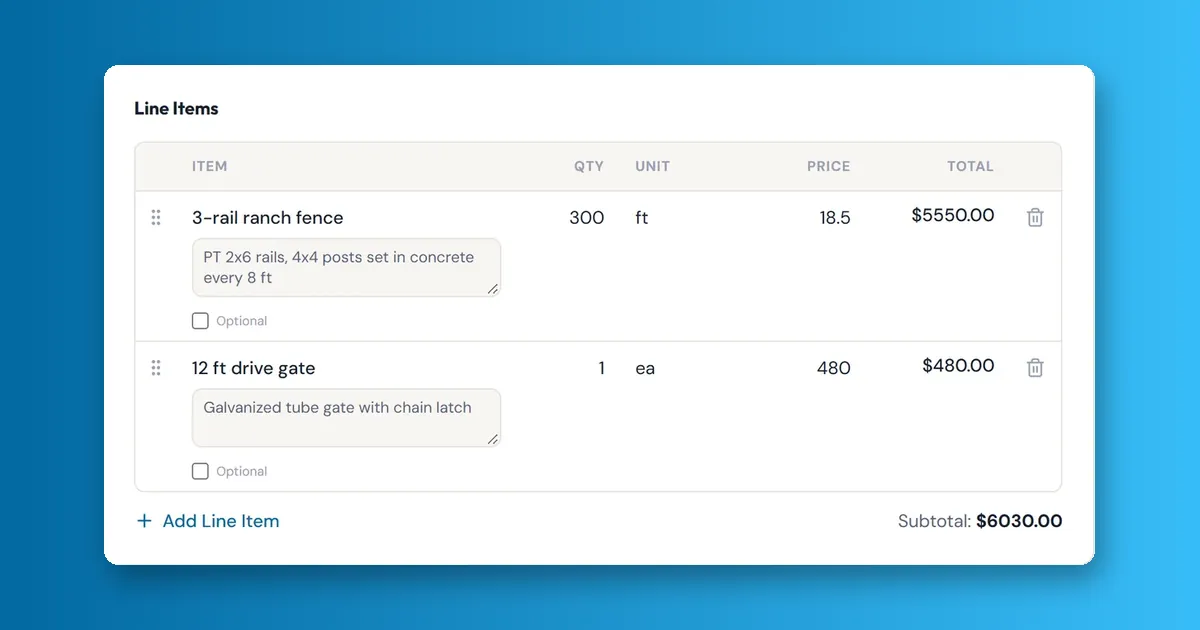
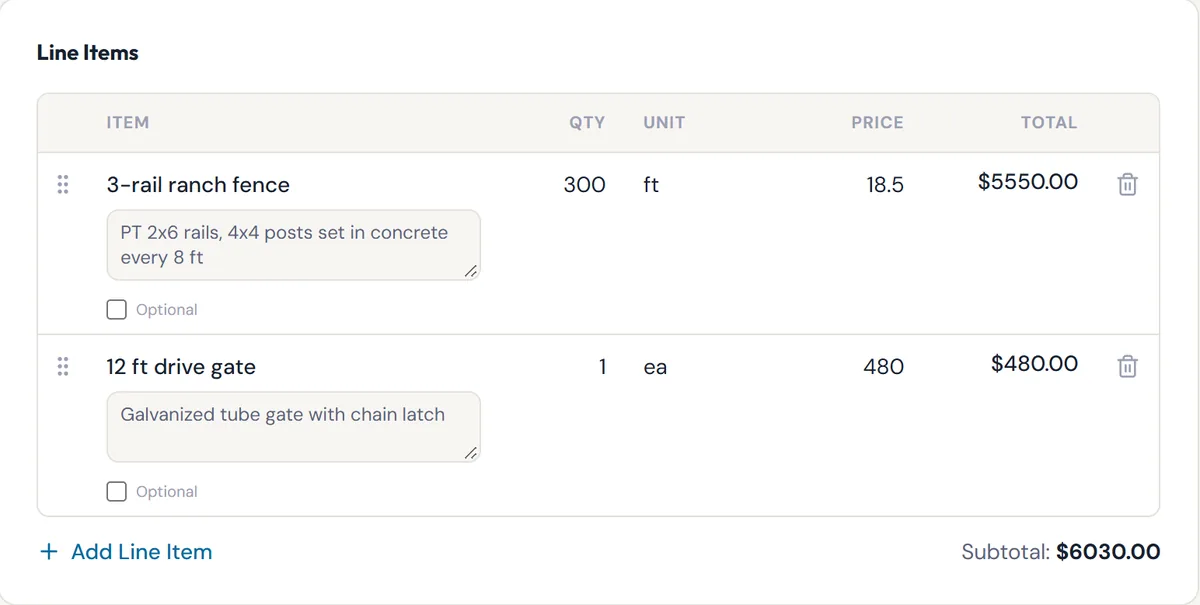
Price it in the Quote Builder. Each line has a title, a short description, a quantity, a unit and a price, and the totals add themselves up. Choose Fixed Price or Time & Materials for the job. The customer sees the lines, not just the bottom number.
The honest gap. Proposals doesn’t store your cost on a line, so it won’t calculate a margin for you. Work out the cost and the price first, with the table above or a spreadsheet, then enter the price. It’s on our list, and I’d rather tell you now than have you hunt for a margin column that isn’t there.
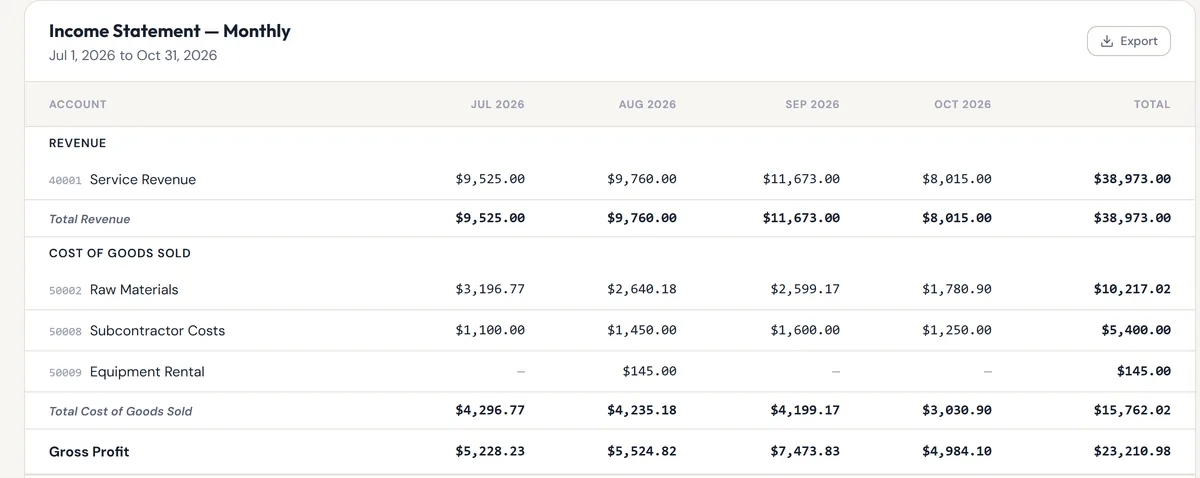
Check the scorecard in Books. When the proposal is accepted, one click turns it into an invoice. If you keep your books in simpleWhirks Books, the monthly Income Statement shows revenue, job costs (materials, subcontractors, equipment rental) and gross profit side by side, month by month. If gross profit is consistently thinner than the margin you priced for, something is missing from your costs. You’ll need to record the invoice and payment in Books too, because Proposals invoices don’t flow into Books automatically yet.
If you’re new to reading these numbers, the 30-minute monthly close is a good habit to pair with your pricing.
About the author. Travis Sutphin is the CTO and co-founder of simpleWhirks. He built Books and Proposals because the alternatives made him angry, and he writes about how they work: what’s stored where, what we chose not to build, and what doesn’t transfer. More from Travis.
Sources cited: U.S. Small Business Administration, Manage your finances · Corporate Finance Institute, Gross Margin
Frequently asked questions
Defined Terms
- Markup
- The amount you add on top of your cost, expressed as a percentage of the cost.
- Gross margin
- The share of the selling price you keep after direct job costs, expressed as a percentage of the price.
- Job costs
- Costs you only have because of a specific job: materials, subcontractors, equipment rental. Books files them under Cost of Goods Sold.
- Overhead
- Costs of running the business that don't belong to one job: insurance, vehicle, phone, software, tools.
- Break-even price
- The price that covers the job's costs and its share of overhead, with nothing left over.
Related reading
Quote vs Estimate vs Proposal: What to Send a Customer
A quote is a fixed price, an estimate is a guess, a proposal is the scope plus the price. Here's which to send, and how a signed one becomes an invoice.
Books · Bookkeeping BasicsMonthly Bookkeeping Checklist: A 30-Minute Close
A monthly bookkeeping checklist you can finish in 30 minutes: import the bank, sort the strays, chase open invoices, check the P&L, then lock the month.