How to Separate Business and Personal Finances
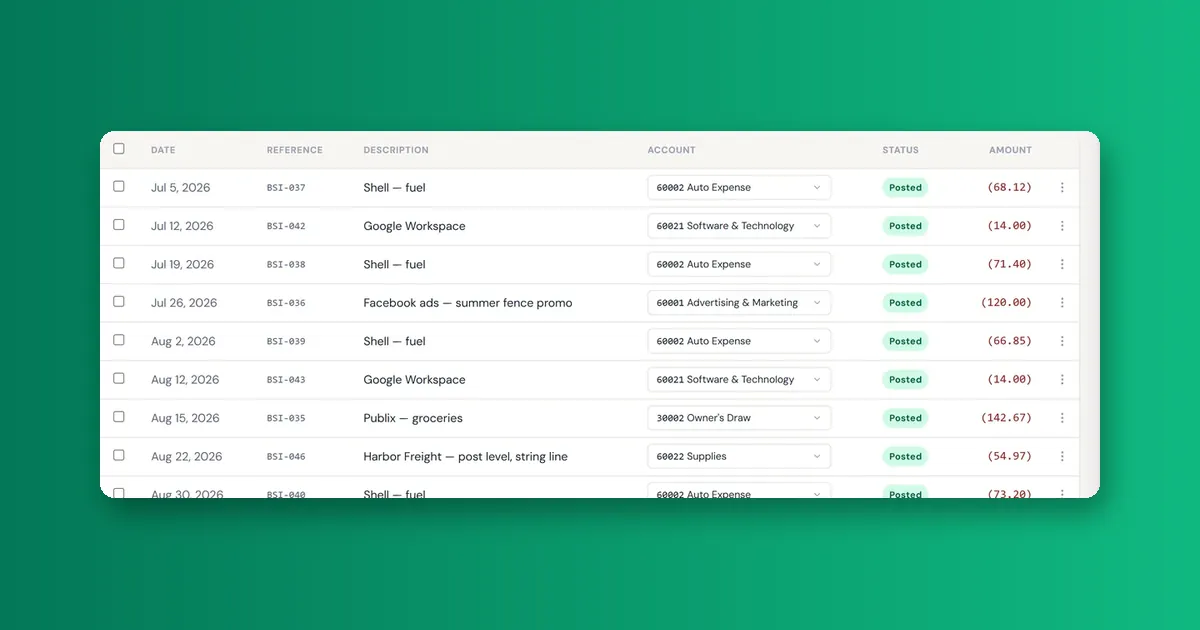
Groceries on the business card happen in almost every small business sooner or later. Picture a landscaper who buys a birthday cake, a set of pruning shears and a tank of gas in one trip and pays for all three with the business card. Completely understandable.
Mixing business and personal money is one of the most normal things a small business does. It’s also one of the easiest to fix, and the fix is mostly two bank accounts and one habit.
Short answer: open a bank account and card used only for the business, pay yourself by moving money to your personal account (an owner’s draw, or payroll if you’re an S corporation), and record any personal purchase on the business card as a draw, not an expense.
Why does keeping the money apart matter so much?
Because separate money gives you true numbers, smaller CPA bills and fewer awkward questions.
When every business transaction lives in business accounts, your profit and loss statement shows what the business really earned. Your deductions are easy to prove, because the receipts and the statement tell the same story. Your CPA doesn’t have to sort personal from business line by line, which is time you’d otherwise pay for.
There’s also a structural reason. If you formed an LLC or corporation, part of what it does is keep the business legally separate from you. Running both through the same account muddies that line. I’m a CPA, not your lawyer, so I’ll leave it there: keeping the money separate is one of the simplest things you can do to let your entity do its job.
What do you actually need to set up?
One business checking account and one business credit or debit card. All business income goes in; all business expenses come out of one of those two.
That’s genuinely it for most small service businesses. Add a business savings account if you want somewhere to park tax money. The SBA’s guide to opening a business bank account lists what banks usually ask for. Then point every customer payment, payment app and supplier account at the business accounts, and cancel any personal autopays that have crept onto the business card.
How do you pay yourself?
How you pay yourself depends on how your business is taxed. Here’s the plain-English version:
| Business type | How you usually pay yourself | Where it shows in your books | Taxes withheld from it? |
|---|---|---|---|
| Sole proprietor | Owner’s draw | Owner’s Draw (equity) | No; you pay income and self-employment tax on the profit |
| Single-member LLC (default tax treatment) | Owner’s draw | Owner’s Draw (equity) | No; same as a sole proprietor |
| Multi-member LLC or partnership | Draws or guaranteed payments | Each partner’s equity, or guaranteed payments | No withholding; partners are taxed on their share |
| S corporation | Reasonable salary through payroll, plus distributions | Wages expense, and distributions in equity | Yes on the salary, through payroll |
The IRS page on paying yourself covers each type. If you’re an S corporation, its guidance on reasonable compensation is worth five minutes.
A habit that helps everyone: pick a pay-yourself day, once or twice a month, and transfer a set amount from business checking to personal checking. Predictable for you, tidy for your books.
Oops, I bought groceries on the business card. Now what?
Record it as an owner’s draw, not an expense. That’s the entire fix.
The purchase still happened, and your books should show it. Filing it to Owner’s Draw says, accurately, “I took $142.67 of the business’s money for myself,” and it keeps the expense lines honest. No guilt required.
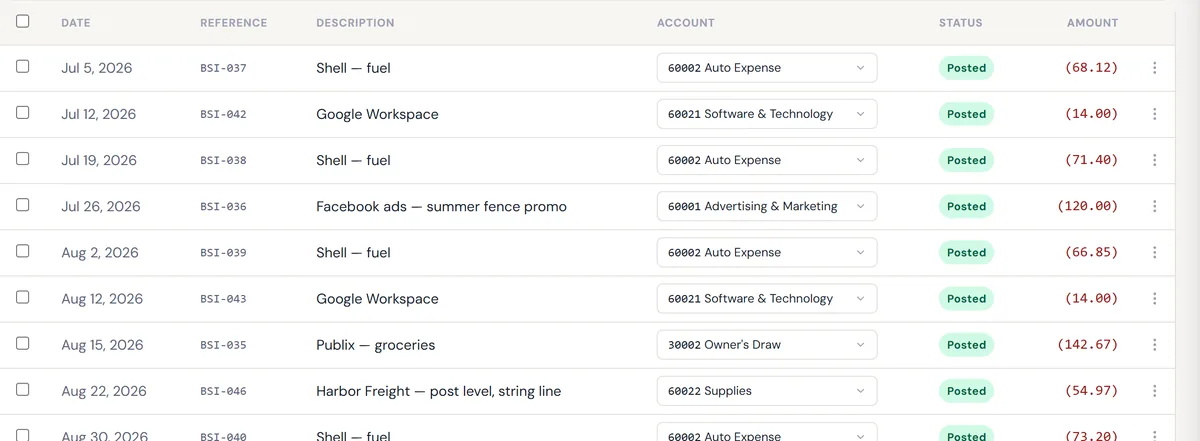
The reverse happens too: you pay a business bill with your personal card because the business card was in the truck. That’s an owner’s contribution (money you put into the business), or you can reimburse yourself from the business account with a short note. Either works, as long as the expense ends up recorded as a business expense.
What if everything’s been mixed for months?
Pick a clean start date, open the business accounts if you haven’t, and untangle the past once.
For the backlog, go through the statements line by line and mark each one business or personal. Business lines get their normal categories. Personal spending from business accounts becomes owner’s draws, and business spending from personal accounts becomes contributions or reimbursements. It’s a long afternoon, not a lost month. Our mid-year bookkeeping cleanup guide walks through a catch-up in order, and once you’re current, the 30-minute monthly close keeps it that way.
Which habits keep it separate for good?
Three small ones do most of the work:
- A pay-yourself day. Regular transfers to personal mean less temptation to use the business card for personal things.
- No personal autopays on business accounts. Streaming, gym and the family phone plan live on personal cards.
- Receipts for the gray areas. Home office, phone, vehicle: keep notes on the business share, because those are the ones your CPA will ask about.
How simpleWhirks Books handles this
Books gives each business account its own register and has the owner accounts ready from day one.
Separate registers. Add your business checking and business card as separate registers and import each statement. Every line gets an account right on the register row.
Owner accounts built in. The default chart of accounts includes Owner’s Capital for money you put in and Owner’s Draw for money you take out. The grocery run goes to Owner’s Draw in two clicks.
Clean reports. Because draws are equity, not expenses, your Income Statement shows the business’s real profit. The Balance Sheet shows what you’ve put in and taken out, so the numbers tie together.

What Books doesn’t do: it doesn’t run payroll. If you’re an S corporation paying yourself a salary, you’ll need a payroll service for that part, and Books records the result.
About the author. Garrett Truman is a Florida CPA (license #AC45159) and virtual CFO who has spent fifteen years helping small businesses get their books into shape, judgment-free about business-card groceries. More from Garrett.
This is general information, not tax or legal advice. How you pay yourself depends on how your business is set up and taxed; ask your CPA about your situation.
Sources cited: IRS, Paying yourself · IRS, S corporation compensation and medical insurance issues · IRS, Publication 583, Starting a Business and Keeping Records · U.S. Small Business Administration, Open a business bank account
Frequently asked questions
Defined Terms
- Owner's draw
- Money you take out of the business for personal use. It's not an expense, and in Books it goes to the Owner's Draw equity account.
- Owner's contribution
- Money you put into the business from your own pocket. In Books it goes to Owner's Capital.
- Commingling
- Mixing business and personal money in the same accounts. Common, fixable, and best avoided.
- Reasonable compensation
- The salary the IRS expects an S corporation to pay an owner who works in the business, before distributions.
- Distribution
- Profit paid out to an owner of an S corporation or similar entity, separate from salary.
Related reading
Monthly Bookkeeping Checklist: A 30-Minute Close
A monthly bookkeeping checklist you can finish in 30 minutes: import the bank, sort the strays, chase open invoices, check the P&L, then lock the month.
Books · Bookkeeping BasicsBookkeeping Basics for Non-Accountants
A plain-English bookkeeping primer for owner-operators. The five terms, three reports, and one daily habit that cover 90% of what you actually need.
Books · Tax & Year-End1099 Filing for Small Business: A CPA's 2026 Guide
Who gets a 1099 in 2026, the new $2,000 threshold, NEC vs MISC, the Feb 1, 2027 deadline, and a step-by-step filing walkthrough from a Florida CPA.