How to Write a Scope of Work That Prevents Arguments
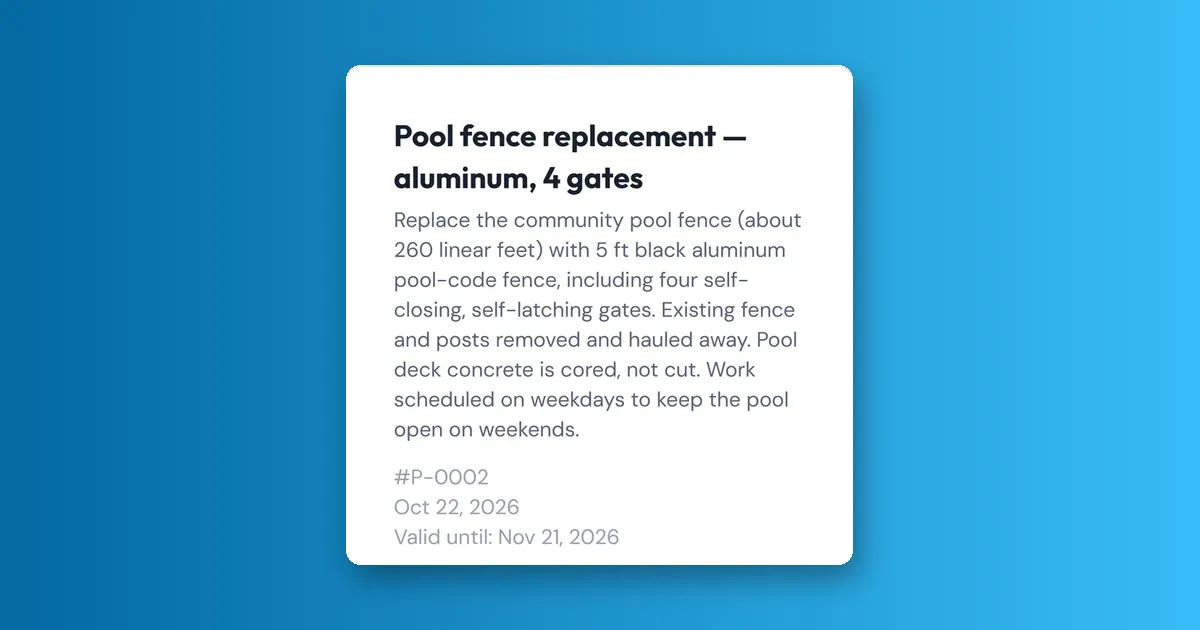
Most bad job stories start the same way. Not with a disaster. With five friendly words: “Oh, while you’re here…”
Nobody means any harm. The customer sees you’re already set up, the extra bit looks small, and you’re a nice person who doesn’t want to be difficult. Three of those later, you’ve done a day of free work and the final invoice feels like an argument.
Short answer: list what you’ll do in the order you’ll do it, name the materials and who supplies them, write down what’s not included and what your price assumes, give a timeline, and say how changes get priced. Plain sentences, one item per line.
What is a scope of work, and why does it save so many arguments?
A scope of work is the written list of what you will and won’t do on a job. It saves arguments because it moves the “I thought that was included” conversation from the end of the job, when everyone’s tired and money’s due, to the start, when it’s just a question.
The part people skip is the part that matters most: what you won’t do. “Install a fence” says what’s included. “Permits and tree removal not included” is the sentence that keeps everyone friends.
What should a scope of work include?
Six parts, and most jobs need only a line or two for each:
- The work, in order. What you’ll do, step by step, with quantities and sizes. “About 120 linear feet” beats “the back fence”.
- Materials, and who supplies them. Type and grade, and anything the customer is providing.
- Exclusions. What a reasonable customer might assume is included but isn’t.
- Assumptions. What your price depends on: clear access, marked utilities, existing posts that are actually sound.
- Timeline. How long it takes and what could move it.
- How changes are priced. One sentence that handles every future “while you’re here”.
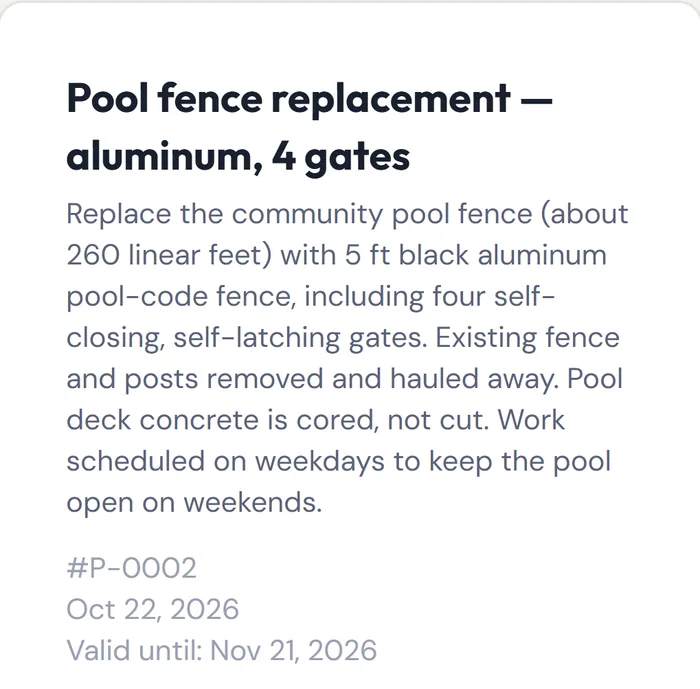
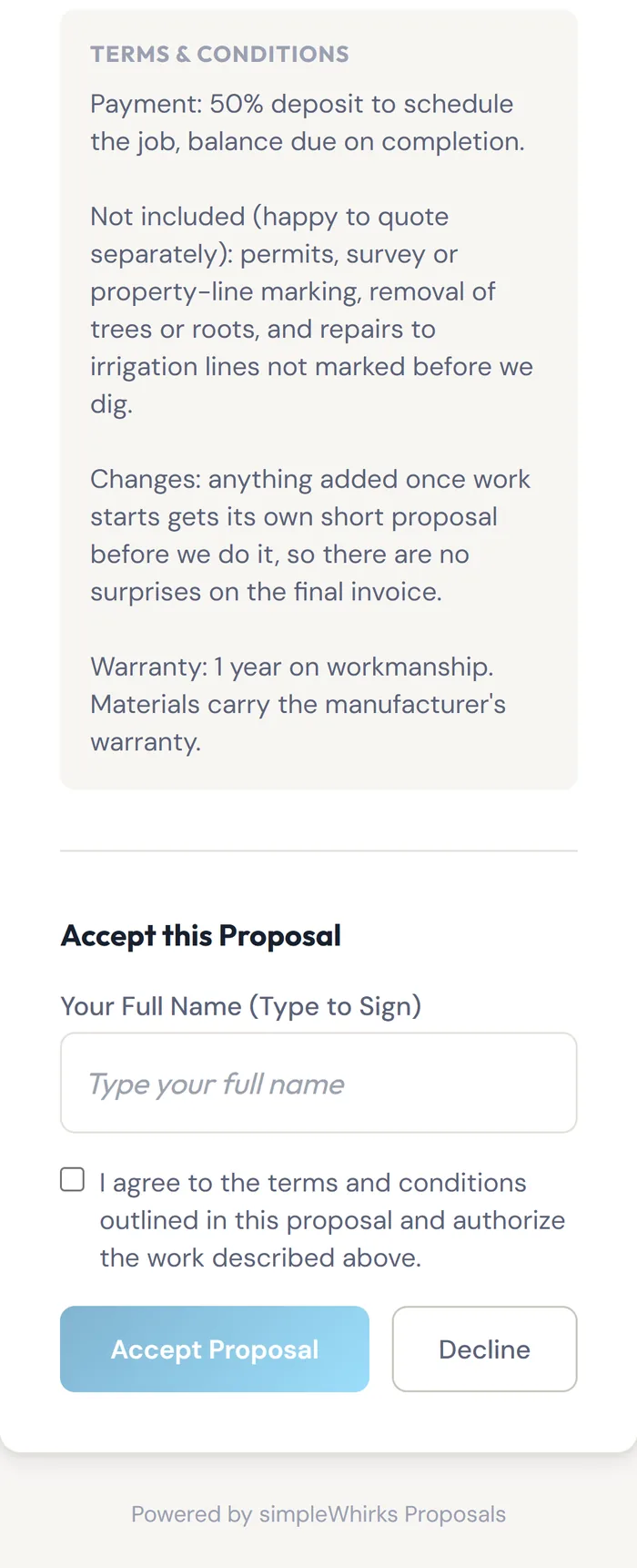
Here’s what that looks like as the customer reads it on their phone:
What does a vague vs. a clear line item look like?
Clear lines say how many, how big, and what happens to what’s already there. Vague lines leave room for two people to picture two different jobs.
| Vague line | Clear line |
|---|---|
| Fix fence | Replace 3 rotted 4×4 posts on the north run, set in concrete, and reattach the existing panels. Panels not replaced. |
| Paint living room | Two coats on walls and ceiling of the living room, color customer’s choice. Trim, doors and furniture moving not included. |
| Lawn cleanup | Mow, edge and blow front and back lawns, and remove leaves from beds. Hauling yard waste over 10 bags is extra. |
| Service AC | Inspect and clean the outdoor and indoor unit, replace the filter, check refrigerant levels. Parts and refrigerant billed separately if needed. |
| Deep clean | Kitchen, two bathrooms and floors throughout, including inside the oven and fridge. Windows and walls not included. |
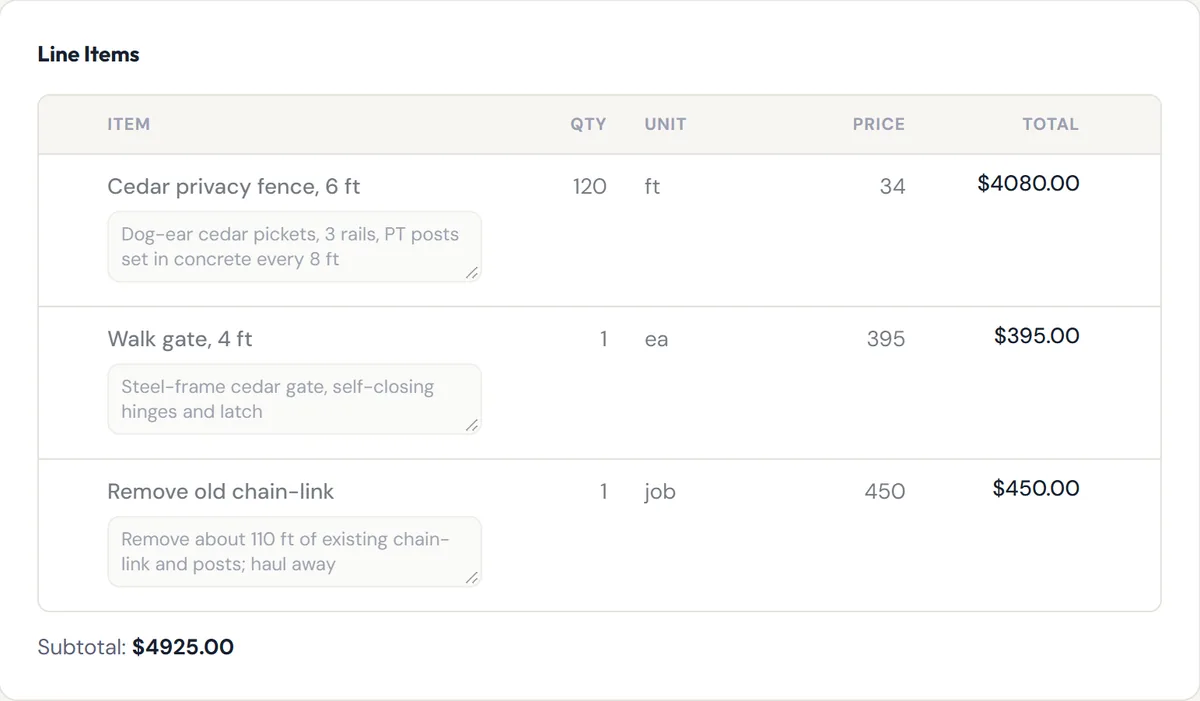
Each line also gets its own short description in your proposal, so the customer doesn’t have to remember what you said in the driveway:
How do you write exclusions without sounding grumpy?
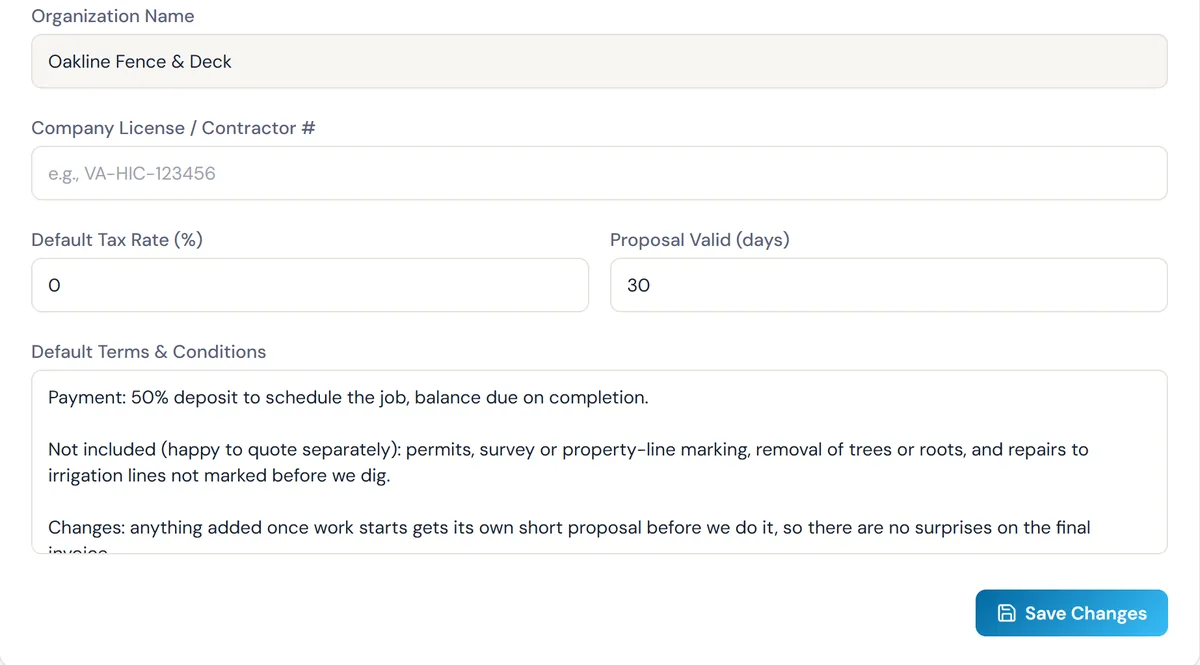
Write them as options, not refusals. “Not included (happy to quote separately): permits, survey or property-line marking, removal of trees or roots” reads like a helpful list, because it is one.
A few patterns that work:
- “Not included, happy to quote separately: …” for things you can do but didn’t price.
- “We’ll need … before we start” for assumptions, such as utilities marked or the gate unlocked.
- “If we find …, we’ll stop and talk before going further” for the hidden stuff, such as rot under siding or roots under the fence line.
Write your standard exclusions once, as default terms, so every proposal starts with them and you only add the job-specific ones.
What do you do when the customer says “while you’re here…”?
Smile, write it down, and send a small new proposal for the added work before you do it.
It feels formal the first time. It isn’t, really: it’s a two-minute proposal with one or two lines, and the customer accepts it from their phone while you finish the main job. Put the rule in your terms (“anything added once work starts gets its own short proposal first”) and it stops being awkward, because you’re just doing what the proposal said you’d do.
How do you get the customer to actually read it?
Keep it short, plain and easy to agree to on a phone. Long paragraphs of legal-sounding language get skipped. A tidy description, clear line items and one accept step get read.
If you’re deciding whether a job even needs a full proposal, our guide to quotes, estimates and proposals helps. And once the scope is clear, pricing the job so it pays you is the next step.
How simpleWhirks Proposals handles this
Here’s what Proposals does today, and where it stops.
Scope in the Description. Every proposal has a Description field for the scope paragraph, and every line item has its own title, quantity, unit, price and a short description.
Exclusions as default terms. Settings → Organization has Default Terms & Conditions. Write your payment terms, standard exclusions and change policy once; every new proposal starts with them, and you can edit them per job.
Easy to read and accept. The customer gets an email with a link, opens it on any phone or computer (no app, no account), types their full name and ticks “I agree”. Their name, the date and time, and where they accepted from are saved with the proposal.
It stays as agreed. Once sent, a proposal can’t be edited, so the scope the customer accepted is the scope on file.
What Proposals doesn’t do yet: there’s no change-order feature, so added work goes on a short new proposal. Acceptance is a typed name, not a drawn signature. And Proposals won’t write legal terms for you. For bigger jobs where warranties or liability matter, have a lawyer look at your standard language once.
About the author
Travis Sutphin is the CTO and co-founder of simpleWhirks. He built Books and Proposals because the alternatives made him angry, and he writes about how they work: what’s stored where, what we chose not to build, and what doesn’t transfer. More from Travis.
Nothing here is legal advice. Contract rules vary by state; talk to a lawyer about terms you plan to reuse.
Frequently asked questions
Defined Terms
- Scope of work
- The written list of what you will and won't do on a job.
- Exclusion
- Something a customer might expect but that isn't included in the price. Best written kindly and offered as a separate quote.
- Assumption
- A condition your price depends on, such as clear site access or existing posts being sound.
- Scope creep
- A job growing piece by piece without the price growing with it.
- Change order
- A written, agreed change to the original scope and price. In Proposals today, a short new proposal does this job.
Sources Cited
- Federal Trade Commission, How To Avoid a Home Improvement Scam
- Cornell Law School, Legal Information Institute, Wex: Contract
Related reading
Quote vs Estimate vs Proposal: What to Send a Customer
A quote is a fixed price, an estimate is a guess, a proposal is the scope plus the price. Here's which to send, and how a signed one becomes an invoice.
Proposals · Winning JobsMarkup vs Margin: How to Price a Job That Pays You
A 20% markup isn't a 20% margin, and the gap is where profit goes missing. Here's the simple conversion, a cheat-sheet table, and how to price jobs right.