Florida Sales Tax for Home Service Businesses (What You Must Collect)

If you run a home service business in Florida, plumbing, HVAC, electrical, lawn care, pest control, cleaning, pool service, handyman work, the question of whether to charge sales tax on a customer invoice is one of the most common reasons clients call me. The short version is that Florida taxes very little service labor compared to most states, but the exceptions are specific and the penalties for getting it wrong are real.
I am a Florida CPA (License #AC45159) and I serve clients across Jacksonville, St. Augustine, Palm Coast, and the rest of northeast Florida. This post is the practical sales tax guide I give new home service clients in their first meeting, written for owners who do their own books and want to know what they actually owe.
This is general guidance, not tax advice for your specific situation. If you have a borderline case (mixed residential and commercial, work that crosses state lines, contractor versus retail classification), call a CPA before you decide. Florida sales tax audits are common for service businesses and the assessment plus penalties can run into five figures fast.
A note on Florida tax law. This post reflects Florida’s sales tax rules at the time of writing. The Florida Department of Revenue publishes updated forms, rates, and surtax schedules every year, and the legislature can change taxable categories. Verify the specifics against floridarevenue.com and the current DR-15DSS surtax table before relying on them, and consult a CPA for borderline cases.
What does Florida actually tax?
Florida taxes tangible personal property (physical goods) plus a short, specific list of services named in Florida Statute 212.05; everything not on that list, including most service labor, is exempt. Most states tax everything unless an exemption applies; Florida starts from the opposite premise.
The 6% state sales tax on services is limited to a handful of categories enumerated in Florida Statute 212.05(1)(i). The categories that show up for home service businesses are:
- Nonresidential cleaning services (NAICS 561720)
- Nonresidential building pest control services (NAICS 561710)
- Detective, burglar protection, and other protection services (NAICS 561611, 561612, 561613, 561621)
If your business performs only residential work in those categories, or any amount of work outside those categories, the labor is not subject to state sales tax. That covers the bulk of Florida home service trades.
The sales tax on commercial real property rent was repealed effective October 1, 2025, when the Florida legislature repealed Florida Statute 212.031. Florida had been the only state that taxed commercial rent. No state or county discretionary sales tax is due on commercial rent for occupancy periods on or after October 1, 2025.
Which home service trades collect sales tax on labor?
Only three home-service categories collect Florida sales tax on labor: nonresidential cleaning, nonresidential building pest control, and detective/protection services. Every residential trade, plumbing, HVAC, electrical, lawn care, painting, handyman, and pool service, is exempt on labor. Here’s the practical breakdown by trade; the column on the right is what most operators in that trade are doing in northeast Florida, a starting point, not a substitute for your own analysis.
| Trade | Labor taxable? | Notes |
|---|---|---|
| Residential plumbing | No | Installed fixtures (water heater, faucet, sink): you pay tax to the supplier, no tax to the customer. Goods sold separately are taxable. |
| Residential HVAC repair | No | Installed equipment (furnace, compressor, line set): you pay tax to the supplier, no tax to the customer. A filter handed over or a window unit sold is taxable. |
| Residential electrical | No | Same pattern: tax paid on installed materials when you buy them; none charged to the customer. |
| Landscaping / lawn care (residential) | No | Plants, mulch, and supplies sold to the homeowner are taxable. |
| Painting (residential) | No | Paint sold separately would be taxable; included in the job, usually not separately taxed. |
| Handyman / general repair | No | Installed materials: tax paid when you buy them. Goods sold separately are taxable. |
| Pool service (residential) | No | Chemicals sold separately would be taxable; routine service labor is not. |
| Residential pest control | No | Treating single-family homes, condos, apartments (per-unit dwellings) is exempt. |
| Residential cleaning / house cleaning | No | House cleaning is exempt; office cleaning is taxable. |
| Nonresidential cleaning | Yes (6% + surtax) | Office buildings, retail, warehouses, restaurants, schools. |
| Nonresidential pest control | Yes (6% + surtax) | Same nonresidential definition. |
| Security / detective / burglar protection | Yes (6% + surtax) | Guard services, alarm monitoring, armored car, private investigation. |
The pattern is straightforward. If you run a trade that touches a residence, you almost certainly don’t collect sales tax on labor. If you run nonresidential cleaning, nonresidential pest control, or any kind of protection or security service, you do.
What about parts and materials sold with a service job?
It depends on whether the part becomes part of the home. Under Florida Administrative Code Rule 12A-1.051, a contractor repairing or improving real property is the end consumer of the materials and fixtures it installs (a furnace, a central AC compressor, the refrigerant and line set that are part of the system, a water heater, a faucet, a sink, hard-wired lighting, a plumbed water softener). You pay sales tax to the supplier when you buy them, and you do not charge the customer sales tax on them.
A lump-sum real property contract does not make the whole invoice taxable. What is taxable is the goods that stay tangible personal property: a filter handed to the customer, pool chemicals sold, a window AC unit sold and plugged in. When you sell those along with exempt labor, list them on their own line and charge sales tax on that line only. Itemizing labor and goods on every invoice keeps the taxable part obvious to you and to an auditor.
Two important wrinkles:
Real property improvement vs. retail sale. Florida distinguishes between contractors who perform real property improvements (where they’re considered the consumer of the materials and pay sales tax to their supplier) and retailers who sell tangible personal property to a customer (and collect sales tax from the customer). Most plumbing, HVAC, and electrical contractors fall under real property improvement, meaning they pay sales tax when they buy parts at the supply house and don’t separately charge their customer. Build the tax you pay at the supply house into your price, and talk to a CPA if you also run a retail counter or sell equipment without installing it.
Use tax on items you bought tax-free. If you bought equipment, tools, or supplies in another state without paying Florida sales tax, you owe Florida use tax (also 6%) when you bring those items into Florida and use them in your business. Most small operators don’t realize this; the most common audit finding is unpaid use tax on out-of-state purchases.
When do I have to register?
You must register for a Florida sales tax permit (Form DR-1) before your first taxable sale: in-state businesses have no dollar threshold (one taxable sale triggers it), while out-of-state remote sellers register after $100,000 in Florida sales in the prior calendar year. For businesses with physical presence in Florida, a single taxable transaction creates the registration obligation. The application is Form DR-1, free, completed online at the Florida Department of Revenue’s registration portal.
For out-of-state remote sellers, Florida enforces the post-Wayfair economic nexus standard: $100,000 in remote sales to Florida customers in the prior calendar year triggers the requirement to register and collect Florida sales tax going forward. This is the rule that catches online retailers and out-of-state service providers who do work for Florida customers without setting foot in the state.
If you provide nonresidential cleaning, nonresidential pest control, or protection services anywhere in Florida and you don’t yet have a sales tax permit, you should register this month. Operating without a permit while collecting (or worse, while not collecting and owing) creates retroactive liability plus penalties and interest. A clean voluntary registration is always cheaper than waiting for the auditor.
What’s the DR-15 and how do I file it?
Form DR-15 is the Florida Sales and Use Tax Return, filed online by the 20th of the month after each reporting period; the Florida Department of Revenue assigns monthly, quarterly, semiannual, or annual frequency based on how much tax you collect in a year, and you must file even when you owe zero. You file it to declare your gross sales, deductible exempt sales, taxable amount, and the tax due. The Florida Department of Revenue assigns your filing frequency based on how much tax you collect per year:
- Monthly: more than $1,000 in tax a year
- Quarterly: $501 to $1,000 a year
- Semiannual: $101 to $500 a year
- Annual: $100 or less a year
Most active home service businesses file monthly. Returns are due by the 20th of the month following the reporting period (May’s return is due June 20). The return itself takes 10 to 15 minutes online if you’ve kept clean monthly records.
If your business paid $5,000 or more in sales and use tax during the state’s prior fiscal year (July 1 to June 30), Florida requires you to file and pay electronically starting with the January return (filed in February of the following calendar year).
Two important rules to internalize:
File even when you owe zero. A period with no taxable sales still requires a DR-15 reporting zero. Missing returns trigger automated penalty notices and, eventually, account suspension.
File and pay on time to keep the collection allowance. Florida currently offers a collection allowance equal to 2.5% of the first $1,200 of tax due (not to exceed $30 per reporting location per period) when you file and pay electronically and on time. The allowance is forfeited for late or paper filers. Late returns also accrue penalty and interest per the rates published by the Florida Department of Revenue.
How do I actually track this in my books?
Track Florida sales tax by tagging each invoice with the customer type (residential vs. nonresidential) and each line item as taxable or exempt at the point of sale, and post taxable and exempt sales to separate income accounts, so your monthly P&L shows the totals the DR-15 asks for. Good bookkeeping makes Florida sales tax small; bad bookkeeping makes it a year-end nightmare.
If your business has a mix of taxable and exempt work (a pest control firm that does both residential and commercial), tag each invoice with the customer type at the point of sale. In simpleWhirks Books, invoices in the Accounts Receivable module (free during early access) let you mark each line taxable or not and apply a tax rate. Keep taxable and exempt sales in separate income accounts and your P&L gives you the totals the DR-15 asks for.
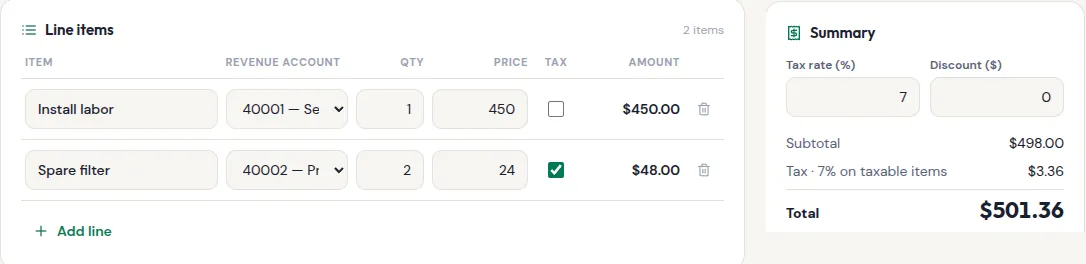
The same logic applies to parts and materials: tag the line item as taxable at the moment you create the invoice. Itemize every invoice (labor and parts on separate lines). Don’t try to back-fill the categorization at month-end; you’ll guess wrong on at least one in twenty invoices and the audit will find that one.
If you’re new to small-business bookkeeping in general, our plain-English bookkeeping basics guide covers the underlying workflow (revenue, expense, reconciliation) that Florida sales tax sits on top of.
Common Florida sales tax mistakes I see at year-end
The five most common Florida sales tax mistakes are invoices that don’t separate taxable goods from labor, treating residential and commercial work the same, forgetting use tax on out-of-state equipment, missing the county discretionary surtax, and going months without reconciling. These five show up in almost every new client’s books from the prior year.
-
Invoices that don’t separate taxable goods from labor. When you sell goods that stay movable (filters, chemicals, a plug-in unit) alongside exempt labor in one unitemized total, you can’t show the auditor which part was exempt. Fix: itemize every invoice.
-
Treating residential and commercial work the same way. A cleaning company that doesn’t split residential vs. commercial revenue can’t substantiate the exempt portion in an audit. Fix: tag each customer at intake.
-
Forgetting use tax on out-of-state equipment purchases. Bought a piece of equipment from a Georgia supplier with no Florida sales tax charged? You owe 6% use tax on the cost. Fix: include use tax accrual in the monthly DR-15.
-
Missing the county discretionary surtax. Most counties impose a discretionary sales surtax on top of the state’s 6% rate, applied to the first $5,000 of any single sale of tangible personal property. Surtax rates change. The current DR-15DSS surtax schedule is published by the Florida Department of Revenue annually; use it to look up the rate for the customer’s delivery county.
-
Letting the books go three months without reconciliation. The DR-15 is built from your sales totals. If your books are wrong, your DR-15 is wrong, and Florida’s audit window is three years (longer if the discrepancy is large). Reconcile monthly.
Frequently asked questions about Florida sales tax for service businesses
Is plumbing labor taxable in Florida?
No, plumbing labor is generally not subject to Florida sales tax. The labor portion of a plumbing service call (drain clearing, fixture repair, water heater installation labor) is not listed among the enumerated taxable services in Chapter 212 of the Florida Statutes. A faucet, water heater, or fittings you install into the home are a different matter: under Florida Administrative Code Rule 12A-1.051, a contractor repairing or improving real property is the end consumer of those materials, so you pay sales tax to the supply house when you buy them and you do not charge the customer sales tax on them. Goods you hand over or sell separately (a spare cartridge, a filter) are taxable to the customer. If you do work that includes nonresidential cleaning (drain cleaning that crosses into “cleaning services”), check with a CPA, because the tax treatment can shift.
Do I have to collect Florida sales tax if I clean offices?
Yes. Nonresidential cleaning services are explicitly taxable in Florida at 6% of the total sales price under Florida Statute 212.05(1)(i), which lists nonresidential cleaning (NAICS 561720). This includes janitorial services for office buildings, factories, warehouses, retail stores, restaurants, schools, and other commercial properties. Residential house cleaning is not taxable, only the nonresidential side. If you clean both residences and businesses, you must charge and remit Florida sales tax on the nonresidential portion. Most commercial cleaning businesses register for a sales tax permit (Form DR-1), collect on every commercial invoice, and file Form DR-15 monthly or quarterly depending on volume.
Is pest control taxable in Florida?
Nonresidential building pest control is taxable; residential pest control is not. Florida Statute 212.05(1)(i) lists nonresidential building pest control (NAICS 561710) as a taxable service, alongside nonresidential cleaning. If you treat homes and apartments (where each unit is a dwelling unit), the labor is exempt. If you treat warehouses, office buildings, restaurants, schools, or retail spaces, the labor is taxable at 6% plus any county surtax. Many Florida pest control companies serve both markets and must split their invoicing: tax on the commercial side, no tax on the residential side. Keep separate records by customer type for audit defense.
Do home service businesses owe sales tax on the parts they sell with a job?
It depends on whether the part becomes part of the home. Under Florida Administrative Code Rule 12A-1.051, a contractor who repairs or improves real property is the end consumer of the materials and fixtures it installs: a furnace, a central AC compressor, the refrigerant and line set that are part of the system, a water heater, a faucet, a sink, hard-wired lighting, a plumbed water softener. The contractor pays sales tax to the supplier when buying them and does not charge the customer sales tax on them, and a lump-sum real property contract does not make the whole invoice taxable. Goods that stay tangible personal property are different: a filter handed to the customer, pool chemicals sold, or a window AC unit sold and plugged in are taxable at 6% plus county surtax when sold separately. Itemize labor and goods on separate lines so the taxable part is clear.
When do I have to register for a Florida sales tax permit?
You must register for a Florida sales tax permit (Form DR-1) before you make your first taxable sale in Florida, whether that’s selling tangible personal property (parts, equipment, retail items) or performing one of the taxable service categories (nonresidential cleaning, nonresidential building pest control, detective and protection services). For out-of-state sellers, the economic-nexus threshold is $100,000 in remote sales to Florida customers in the prior calendar year. There is no de minimis dollar threshold for in-state businesses with physical presence: one taxable sale triggers the registration requirement. The application is free and is completed online through the Florida Department of Revenue.
What is Form DR-15 and how often do I file it?
Form DR-15 is the Florida Sales and Use Tax Return. Every business with a Florida sales tax permit files a DR-15 to report total sales, taxable sales, exempt sales, and the tax due. Filing frequency is assigned by the Florida Department of Revenue based on the tax you collect in a year: more than $1,000 a year files monthly, $501 to $1,000 files quarterly, $101 to $500 files semiannually, and $100 or less files annually. Returns are due by the 20th of the month following the reporting period. If your business paid $5,000 or more in sales and use tax during the prior state fiscal year (July 1 to June 30), Florida requires you to file and pay electronically starting with the January return (filed in February). Even when you owe zero tax for a period, you must file a DR-15 reporting zero.
About the author
Garrett Truman is a licensed Florida CPA (License #AC45159) and co-founder of simpleWhirks. He has spent over twenty years working with small businesses across northeast Florida, including as a virtual CFO for home-based businesses, trades, and owner-operators. He is the author of The Little Simple Startup Book and writes the simpleWhirks Books blog on bookkeeping cleanup, Schedule C, and small-business tax strategy. Read more · LinkedIn
Florida tax law and Department of Revenue forms change. This post is reviewed periodically against the cited primary sources; use the links below to verify the current statutes, rates, and surtax schedules before relying on them for a tax decision.
Frequently asked questions
Defined Terms
- Nexus
- The legal connection between a business and a state that creates a tax obligation. For Florida sales tax, in-state physical presence creates nexus instantly; out-of-state remote sellers establish nexus at $100,000 in Florida sales in the prior calendar year.
- Taxable service
- A service category specifically listed in Florida Statute 212.05 as subject to sales tax. Florida taxes only a narrow list of services (most labor is exempt); the three relevant to home service businesses are nonresidential cleaning, nonresidential pest control, and detective/protection services.
- Exemption certificate
- A signed document from a customer that documents why a sale is exempt from sales tax. Common examples: a resale certificate (customer is buying for resale), a government entity exemption, or a religious/charitable organization exemption. Keep certificates on file for three years; without one, the seller owes the tax.
- Discretionary surtax
- A county-level sales tax added to Florida's 6% state rate. County surtaxes vary by county and change from year to year; the Florida Department of Revenue publishes the current rates annually on Form DR-15DSS. The surtax applies on top of the state 6% on the first $5,000 of any single sale of tangible personal property.
- DR-1
- The Florida Business Tax Application. The single form used to register for sales tax, use tax, communications services tax, and several other Florida tax types. Submit before your first taxable sale. The permit is issued by the Florida Department of Revenue after the application is processed.
- DR-15
- The Florida Sales and Use Tax Return. The monthly, quarterly, semiannual, or annual return that reports gross sales, taxable sales, exempt sales, and the tax due. Filed online through the Florida Department of Revenue. Due the 20th of the month following the reporting period.
Sources Cited
- Florida Statute 212.05 (Sales, storage, use tax)
- Fla. Admin. Code R. 12A-1.051 (Contractors)
- Florida Department of Revenue, Florida Sales and Use Tax
- Form DR-15, Sales and Use Tax Return
- DR-15DSS Discretionary Sales Surtax Information
- Florida Department of Revenue, Business Registration (Form DR-1)
- Florida Department of Revenue, Sales and Use Tax on Cleaning Services (GT-800015)
Related reading
QuickBooks Alternatives for Small Business in 2026
An honest, builder's-eye comparison of the best QuickBooks alternatives for small business in 2026: pricing, fit, what transfers, and what doesn't.
Books · Bookkeeping BasicsBookkeeping Basics for Non-Accountants
A plain-English bookkeeping primer for owner-operators. The five terms, three reports, and one daily habit that cover 90% of what you actually need.